
Movement
End Laps Opening Down Long Runs
- You See
- Gaps at the end laps partway down long panel runs.
- What It Means
- Long runs grow and shrink more. End laps get stitched and reinforced in every phase.
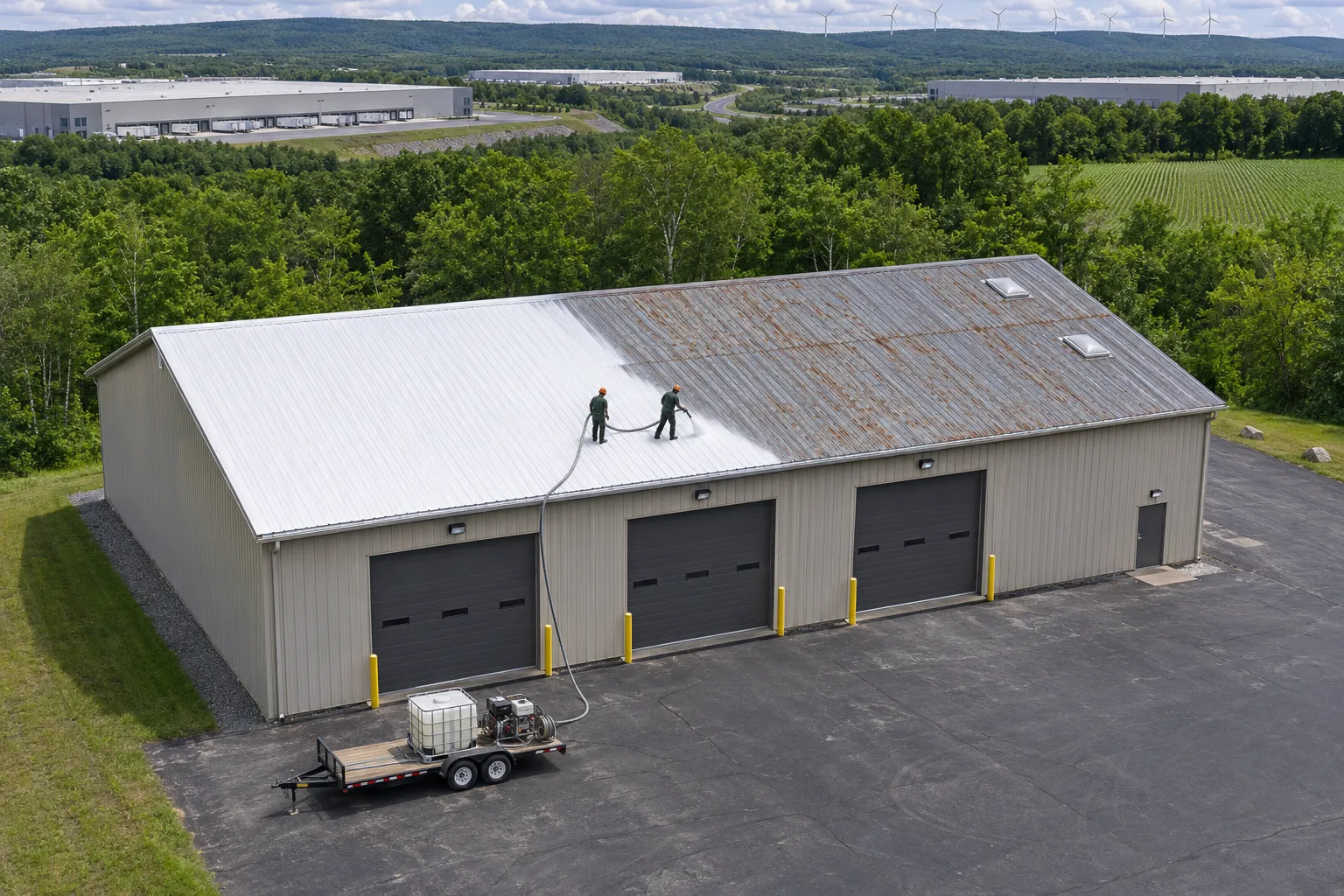
As a Bloomsburg metal roof coating contractor, we coat warehouse and distribution roofs in planned phases, so each finished bay stays watertight while the next one waits.
Bloomsburg metal roof coating on a large warehouse rarely has to happen all at once. We split the roof along ridges, laps, or firewalls, finish each bay to full thickness, and seal the edge where coated meets uncoated. The plan covers shared gutters and drains so the next phase never sends water against fresh work.
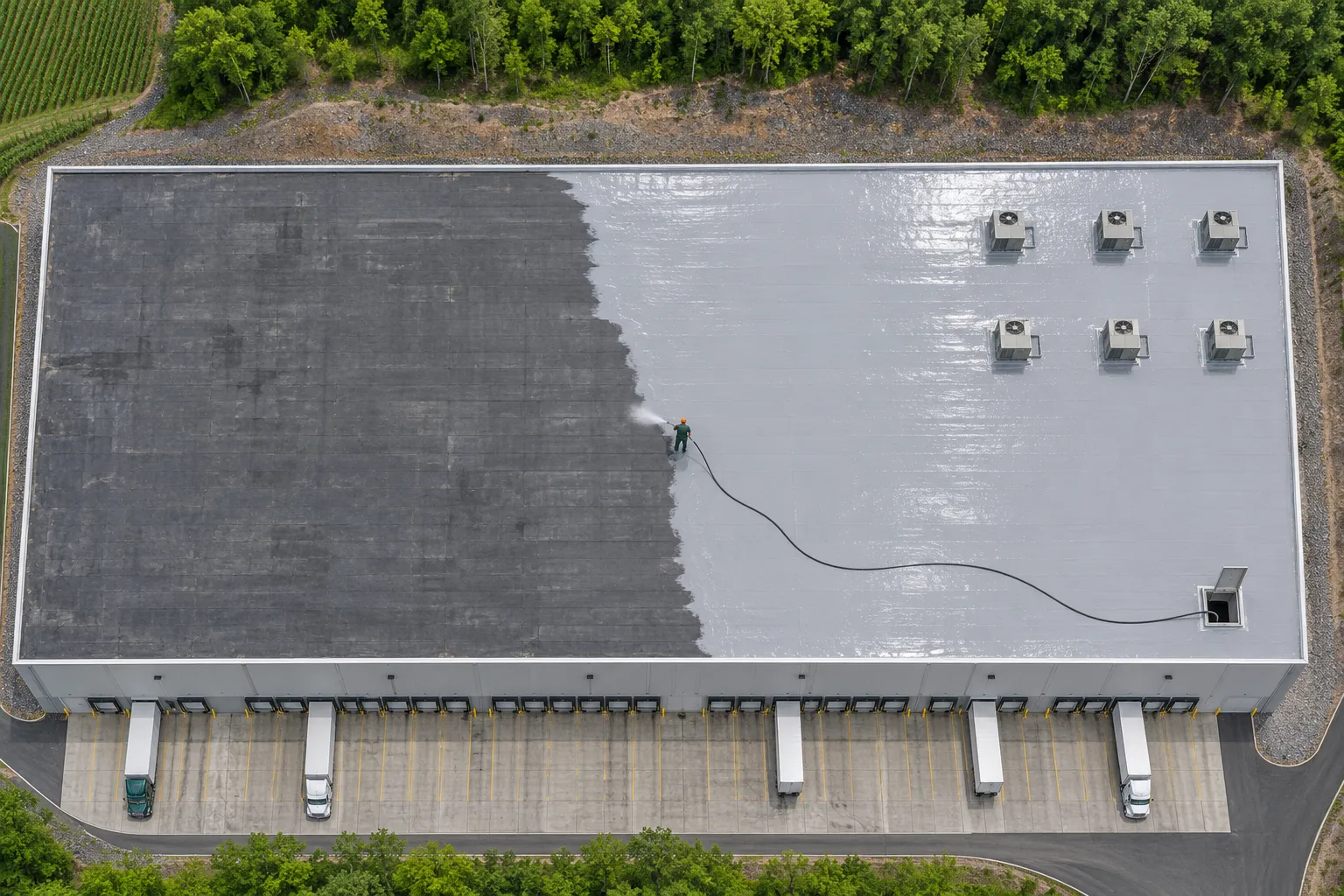
Large warehouse roofs show the same wear in many places at once. These four decide how the phases are drawn.
Coating in phases spreads the work and the cost. Here is what each finished bay gains.
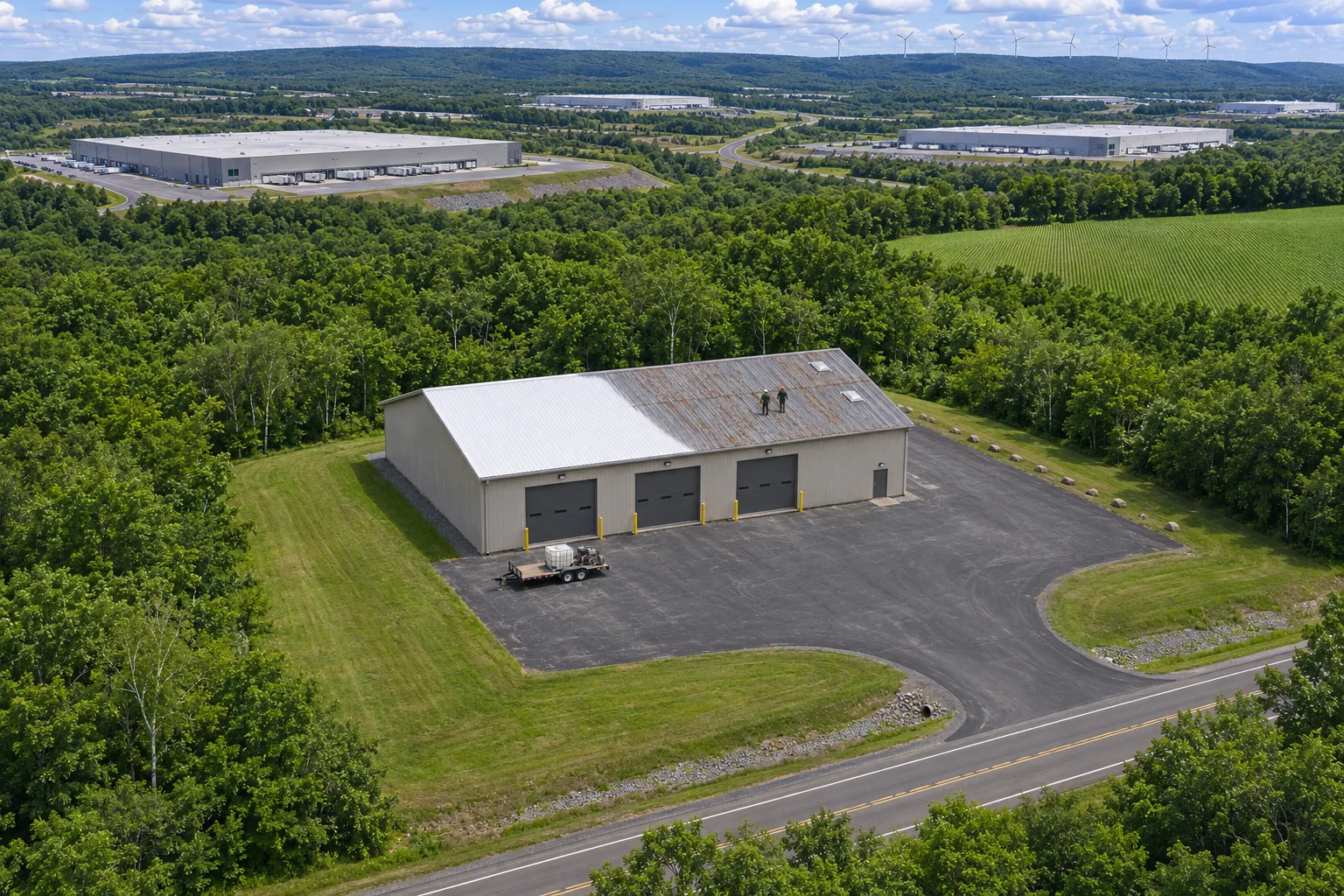
The bay over stock or offices can go first, so the worst drips end early. Offices and stock areas under that bay stay dry from the first phase on.
Phases can follow your budget year, with each one closed tight in between. Each phase is sized to what fits your budget that season.
Only one bay of work happens overhead at a time, so the rest of the floor keeps moving. Forklifts and pickers below the other bays keep their normal routes.
The same system and thickness in every phase gives one consistent roof at the end. A written record of each phase keeps the system the same from start to finish.
Phased warehouse roofs usually take one of these approaches.
Each bay gets screws, laps, rust, and two coats before work moves to the next section. Every bay gets a sealed edge at the end of its phase.
Every lap and screw line is fixed in one push, then the field coats follow in phases. This approach stops most leaks quickly while the coating waits for budget.
Valleys between bays that hold water take silicone at an approved edge. The valley detail is built once and tied into each bay as it is coated.
Sloped bays that drain well take acrylic in mild weather. Pitched bays get fabric at every lap before the acrylic goes on.
A ballpark range for the whole roof makes it easier to split into phases that fit your year.
A phased job adds planning at the start and a sealed edge at the end of every phase.
The whole roof gets walked, even if only one bay is coated this year, so the phase lines fall where they work. The full walk keeps every phase consistent with the plan.
You get a plan showing each bay, its order, and how gutters and drains are handled between them. Phase order follows leaks, budget, and how the floor is used.
Screws, laps, and curbs in the first bay are repaired, and rust is cleaned and primed. Shared gutters get fixed here, even if the bay beside them waits.
The bay is coated to full thickness, and its edge is sealed where it meets the next section. Wet-film readings are taken across the bay as the coating goes down.
Later phases use set access routes, so nobody walks across a coated bay with tools or totes. Totes and hoses are kept off coated panels for the rest of the job.
Bloomsburg is one of five towns we serve around Hazleton. Building somewhere else? Give us a call or send a message.
Bottling roofs prepped with product and intakes protected.
Rusted-through shop panels replaced before the coating.
Workshop roofs opened up and leaks traced first.
Edge metal, gutters, and closures repaired on block roofs.
What warehouse owners here ask about phased coating.
Yes, as long as each phase ends at a stopping point that stays weather-tight. We check shared drainage and the joint between coated and uncoated areas first. The same product family is used throughout, and access routes are set so later phases leave finished bays alone.
The phase plan also lists what each bay needs, so later work starts where the last phase ended.
We do. Shops, offices, and small warehouses get the same inspection and repair list as a big distribution roof. A small roof is usually coated in one phase, often in a few days of good weather. Small roofs still get a written list of the screws, laps, and curbs that need work.
Start with the bay that leaks most or sits over the most valuable space. Draw phase lines at laps, ridges, or walls, fix shared gutters in the first phase, and keep the same coating system for every bay. Phase lines that follow laps or ridges are the easiest to seal and the easiest to find later.
Each phase repeats some setup, such as lifts and staging, so phasing adds a little. Coating plans out at about $2.50 to $4.00 per square foot of roof; prep, access, and the number of phases move a job within that range. Fewer, larger phases keep setup costs down, while more phases spread spending over more seasons.
Before a phase ends, we fix any active leaks in the bays still waiting. They stay as they were, with their worst joints sealed, until their turn comes the next season. Any new leak in a waiting bay gets patched with material that the later coating will bond to.
Get a planning range for the full roof, or call to walk it and draw the phases.